Silverside Adaptation
Silversides are small but their genomes are mighty interesting
 Maria Akopyan
  Arne Jacobs
  Jessi Rick
  Áki Jarl Láruson
  Aryn Wilder
  Emma Arboleda
 It has become evident that fisheries can inflict evolutionary changes in the exploited populations, but the full extent of these changes and their impacts on future fisheries yields and sustainability remain an open question. Using high-throughput DNA sequencing methods, we have revisited a seminal study, which demonstrated that experimental size-selective harvesting of Atlantic silversides (Menidia menidia, a small marine fish) caused substantial changes in growth rates and a suite of other traits over less than four generations. Characterizing the genomic basis underlying these observed changes will improve our mechanistic understanding of how fisheries-induced evolution operates, and will illustrate which genomic impacts we may expect in wild commercial fish stocks if they have undergone similar evolution due to fishing pressure.
Oceans are large, open habitats, and it was previously believed that their lack of obvious barriers to dispersal would result in extensive mixing, preventing organisms from adapting genetically to particular habitats. It has recently become clear, however, that many marine species are subdivided into multiple populations that have evolved to thrive best under contrasting local environmental conditions. Nevertheless, we still know very little about the genomic mechanisms that enable divergent adaptations in the face of ongoing intermixing. In addition to the cod projects described above, we are using the Atlantic silverside (Menidia menidia), as a model for advancing our knowledge in this area. The Atlantic silverside is a small estuarine fish that exhibits a remarkable degree of local adaptation in growth rates and a suite of other traits tightly associated with a climatic gradient across latitudes. Decades of prior lab and field studies have made it one of the marine species for which we have the best understanding of evolutionary tradeoffs among traits and drivers of selection causing adaptive divergence. Yet, the underlying genomic basis is so far completely unknown.
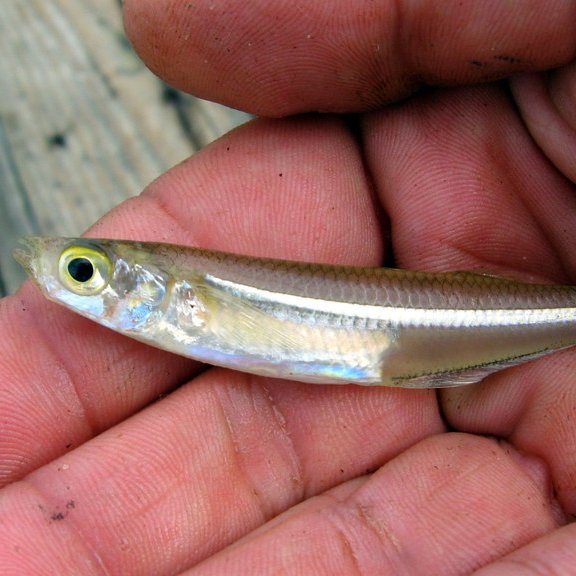 The humble Atlantic Silverside (Minidia minidia)
Along with our collaborator Hannes Baumann at the University of Connecticut, we are generating a reference genome along with linkage maps and quantitative trait locus maps, and are using whole genome sequencing data from fish collected across the distribution range to characterize the genomic basis and architecture underlying local adaptation in this species. Varying levels of gene flow up and down the east coast of North America create a natural experiment for testing general predictions about the genomic mechanisms that enable adaptive divergence in the face of gene flow. To better understand the mechanisms involved, we are also collecting time series of samples from several locations to directly study how dispersal - selection dynamics play out over seasonal time scales. This should help us infer whether or how selection against migrants and their offspring maintains local adaptation despite homogenizing connectivity and how the remarkable degree of local adaptive divergence across the environmental cline.
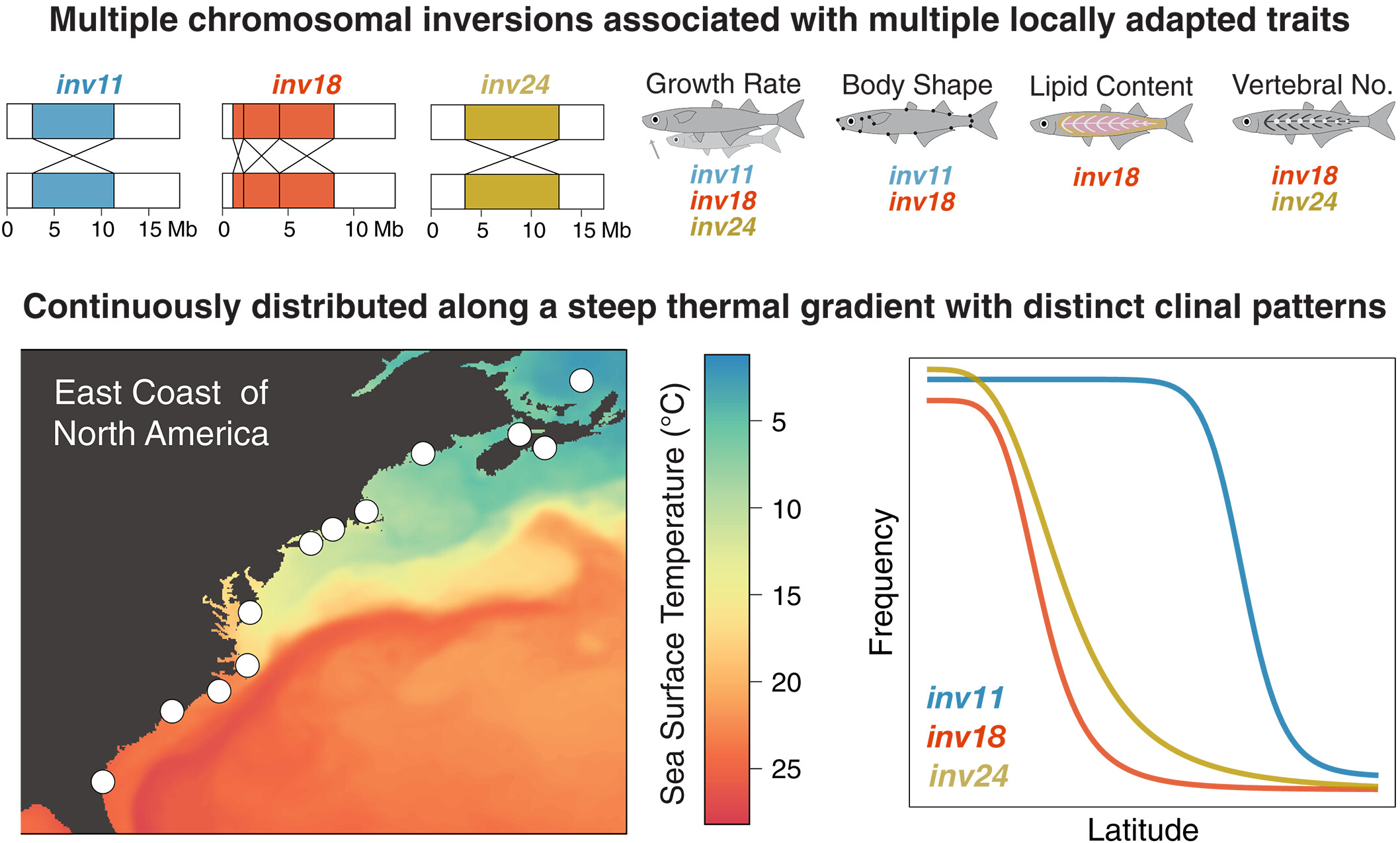 Three large chromosomal inversions (inv11, inv18, and inv24) are each associated with clinal variation in multiple adaptive traits—growth rate, body shape, lipid content, and vertebral number in Atlantic silversides. These inversions show distinct clinal patterns along the steepest coastal sea surface temperature gradient on Earth—the latitudinal gradient of the North American Atlantic coast. All three inversions show opposite haplotypes fixed (or nearly fixed) at the northern and southern range limits, but the latitude where haplotype frequencies shift differs for each inversion.
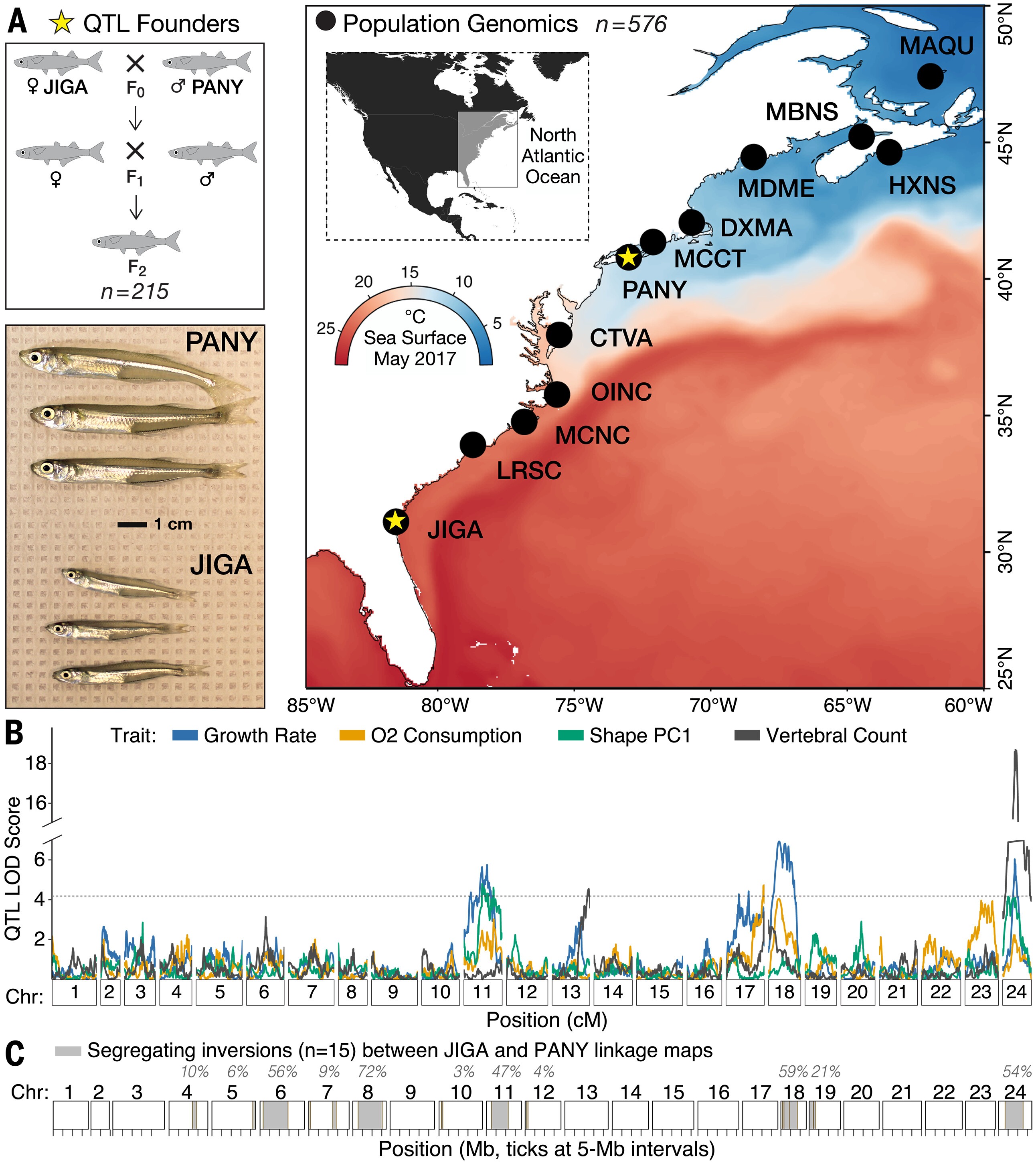 Fig. 1. Inversions on chromosomes 11, 18, and 24 colocalize with QTL. (A) Experimental design: Wild-caught fish from Jekyll Island, GA (JIGA) and Patchogue, NY (PANY) (yellow stars on map) were intercrossed to create an F2 family for QTL mapping. Photo of lab-reared silversides of the same age showing genetically based growth rate differences between JIGA and PANY. Silverside range showing 12 sampling sites (black points) for population genomic analyses, with a sea surface temperature gradient (NOAA Coral Reef Watch). (B) Genome-wide QTL scan: LOD scores and significance threshold (dotted line) for four traits, with a break in the y-axis. (C) Positions of inversions: in megabases (gold, from 20) with size (percent of chromosome) above. Note: The units for positions differ between (B) (megabases) and (C) (centimorgans). Suppressed recombination across inversions precludes calculation of genetic positions (centimorgans).