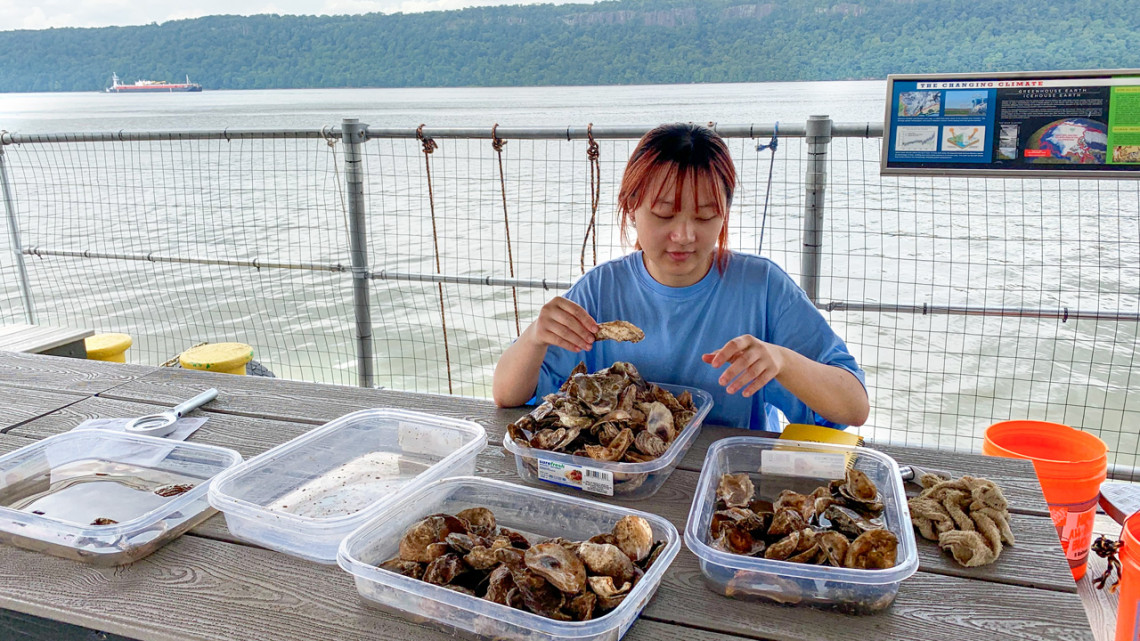
Yuqing's work with Matt Hare was featured on Cornell's website and we are really proud of her. A lab alum, Harmony, was also involved in this work, so it's great that both of them have been spotlighted by the university. Yuqing's work is showing that oyster farming may be doing more than producing seafood—it could also be helping restore wild oyster populations in New York waters. Her new study published in Molecular Ecology (link) found the first genetic evidence that farmed eastern oysters are reproducing and mixing with wild oyster populations in parts of Long Island Sound. By analyzing genetic markers associated with domesticated oyster strains, they discovered signs of farmed ancestry in wild oysters from the East River and Connecticut waters, while oysters from the Hudson River—where oyster farming is prohibited—showed little evidence of such mixing.
Their findings suggest that oyster farms could provide an unexpected conservation benefit by supplementing declining wild populations. Eastern oysters once formed vast reefs throughout New York estuaries, but overfishing, pollution, and habitat degradation have reduced their numbers dramatically. Because oyster larvae can drift for weeks before settling, offspring produced on farms may disperse into nearby natural habitats. While the long-term ecological effects of this genetic mixing remain unclear, the traits selected in farmed oysters, such as disease resistance, could potentially strengthen wild populations. Unlike many forms of aquaculture that can negatively impact surrounding ecosystems, oyster farming may offer a rare example of food production that also supports water quality and ecosystem restoration. Great job, Yuqing, Matt, and Harmony!
You can read the article in full here